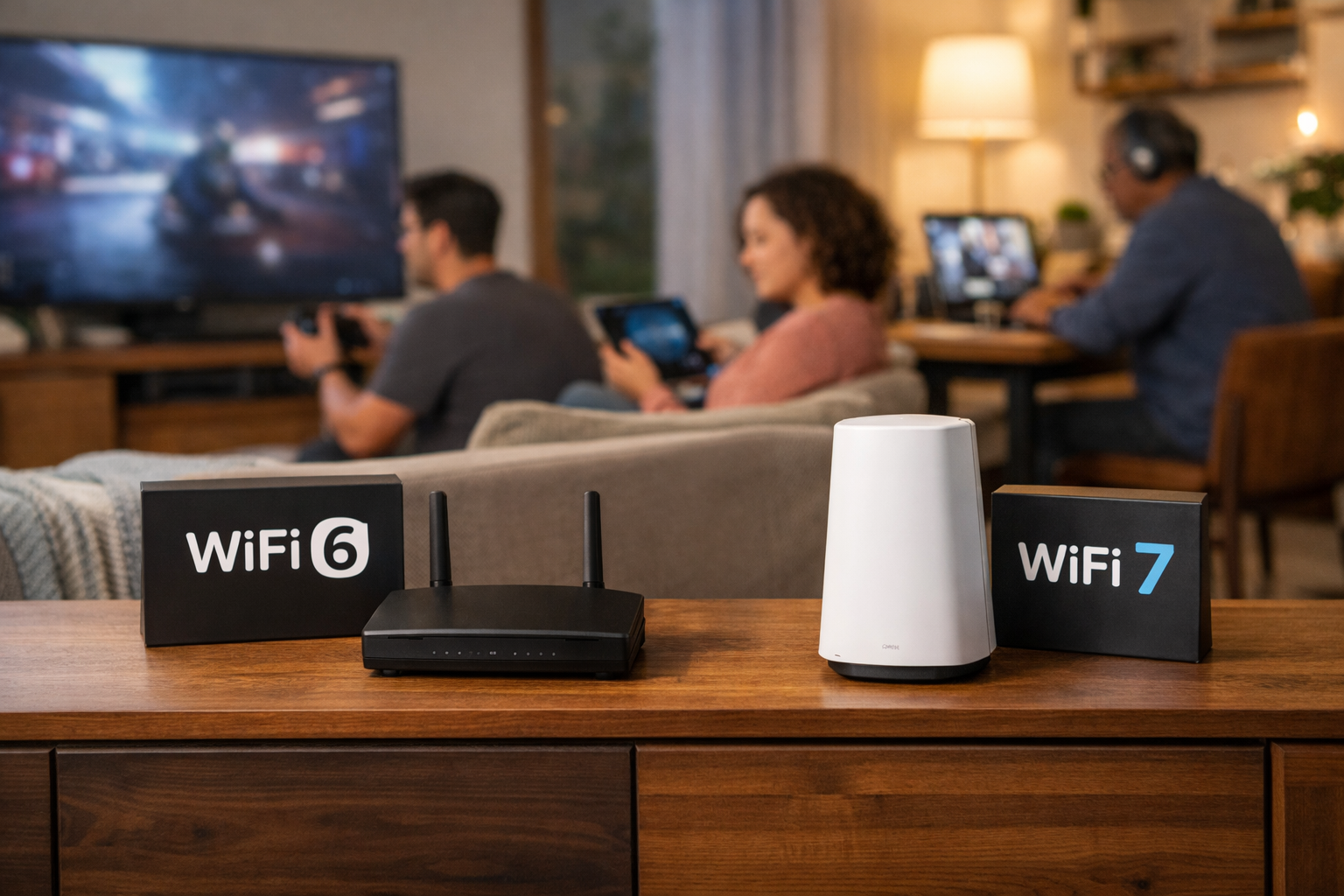


A wireless mesh network is a Wi-Fi system where multiple pieces of equipment work together to provide coverage throughout your entire home or business. Instead of relying on a single router, a mesh network uses a router in combination with mesh nodes (sometimes called pods) to create a cohesive network. Nodes are placed in different areas throughout your space. Essentially, they communicate with each other, creating a "mesh" of coverage. Since devices can automatically connect to the nearest node, mesh networks help minimize dead zones and provide consistent connectivity wherever you go.
If you're experiencing a slow internet connection, you may find that upgrading your connection speed won't do enough to solve your problem. You may need to consider your network too. If you have a single router that struggles to broadcast your Wi-Fi signal throughout your space, a wireless mesh network can make a big difference by extending your coverage.
In this guide, we'll explore how mesh networks work, their benefits, and how to determine if one's right for your space.
How a mesh network works
A Wi-Fi mesh network operates differently from a traditional router. It uses a main mesh router and one or more nodes to create overlapping Wi-Fi coverage throughout your space. The Wi-Fi nodes within a particular space communicate with each other to provide multiple paths for your data to travel.
When you connect to a Wi-Fi mesh system, your device automatically finds the nearest node with the strongest signal. Devices can also switch seamlessly from one node to the next as you change locations. This mesh coverage lets your data find another route if one path becomes congested.
Mesh systems increasingly use the latest Wi-Fi 7 technology to help deliver improved coverage, faster speeds, and stronger signals.
Benefits of a Wi-Fi mesh network
Wireless mesh networks offer several advantages over a traditional router setup for connecting homes and offices.

Expanded coverage for larger spaces
Mesh networks can extend Wi-Fi coverage throughout large homes, multi-story offices, and buildings with thick walls that can block signals. By placing nodes in different areas, you create overlapping zones that help minimize weak signal areas.
Improved reliability through redundancy
Because mesh networks use multiple interconnected nodes, they offer better reliability than single-router setups. If one goes offline, a mesh network can automatically reroute traffic to maintain your connection.
Scalable and flexible setup
Wi-Fi mesh systems are designed to grow with your needs. You can start with a basic one- or two-node setup and add more later if you move to a bigger space or need additional coverage.
Better performance with multiple devices
Most homes and offices have multiple devices connected at once—phones, laptops, tablets, smart home gadgets, gaming consoles, and streaming services. Instead of forcing one router to handle all this traffic, mesh networks distribute the signal across multiple nodes. This can help improve performance when you're using a lot of bandwidth.
Mesh network vs. router and extenders
Mesh nodes work differently than extenders, which are used to boost the signal from a traditional router. When comparing a mesh network to a traditional router with extenders, it's important to understand how they both work.
A traditional router sends one signal throughout your space. The router's coverage can be boosted via an extender, which takes the original signal and then rebroadcasts it to extend the range. The main drawback is that each extender creates a separate network with a different name, requiring you to manually switch between networks. Extenders can also reduce your overall bandwidth because they use the same channel for transmitting and receiving data.
In contrast, wireless mesh networking uses one or more nodes to create a single network. By distributing the signal, a mesh network can deliver more consistent coverage across larger spaces. Learn more about the differences between Wi-Fi range extenders and wireless mesh networks.

Choosing between a traditional router and mesh network
Whether you're setting up a new Wi-Fi network or expanding an existing one, consider your space and connectivity needs to find the right fit.
| Your situation | Better fit |
| Space under 1,500 sq. ft. with open floor plan | Traditional router |
| Space over 1,500 sq. ft. and up to 3,500 | Mesh router plus one mesh pod |
| Centrally located router, few devices | Traditional router |
| Thick walls, unusual layout, many devices, over 3,500 sq. ft. | Mesh router plus one or more mesh pods |
| Need consistent coverage throughout space | Mesh router plus one or more mesh pods |
Things to know when choosing a mesh network
While mesh networks have many advantages, it's important to keep a few things in mind. Mesh systems can cost more upfront than a single router, and the initial setup may require a bit more planning when deciding where to place nodes. Additionally, not all spaces need a mesh solution. If you have a smaller home with good coverage from a single router, a mesh network may be more than you need. Many spaces only need one mesh node to achieve excellent coverage.
Setting up a new Wi-Fi mesh network
Installing a mesh network is pretty straightforward. Your mesh router needs to connect to your internet modem. Additional nodes should be placed within range of each other, no further than two rooms or one floor apart. Keep nodes away from metal objects, thick walls, and sources of interference like microwaves.
Most mesh systems come with a mobile app that guides you through setup, from naming your network to finding optimal locations for the nodes. Once your system is running, keep firmware updated, monitor your network through the app, and adjust node placement if needed.
Frequently asked questions about mesh networks
Do mesh networks need to be hardwired?
No, mesh networks don't need to be hardwired. Nodes are typically plugged directly into outlets and communicate wirelessly with each other. However, some systems support wired connection with Ethernet cables, which can improve performance and reliability for high-bandwidth needs.
Does mesh Wi-Fi work through walls?
Yes, mesh Wi-Fi signals can pass through walls. However, concrete and metal can weaken the signal. The advantage of a mesh network is that you can place nodes on different sides of walls and floors to help ensure coverage reaches areas that might be blocked.
How many nodes do I need to ensure coverage?
The number of nodes you need depends on the size, layout, and construction materials of your space. As a general rule, a two-node system can work for homes up to 3,000 square feet, while larger homes or those with multiple floors may need more nodes. Many mesh systems are flexible enough to expand as your needs change.
Can I add more nodes to my mesh system later?
Yes, most systems allow you to add nodes. If you move to a larger space, you can expand your mesh network with additional nodes. Just be sure you purchase nodes that are compatible with your existing setup.
What internet speeds do I need for mesh Wi-Fi to work well?
A mesh network can work with any internet speed, but to take full advantage, you'll want internet speeds that match your needs. Keep in mind that a mesh network distributes your existing internet connection more evenly throughout your space — it doesn't increase the speed of your internet service itself.
Do I need Wi-Fi 6 or Wi-Fi 7 for my mesh network?
While older Wi-Fi standards can work with mesh networks, newer technologies like Wi-Fi 6 and Wi-Fi 7 offer significant advantages. Wi-Fi 7 can deliver improved coverage over Wi-Fi 6, along with faster speeds, better performance for multiple devices, and stronger signals. If you're investing in a new mesh system, choosing one with Wi-Fi 7 can help future-proof your network and provide a great connectivity experience.
Maximizing your connected home with mesh networking
Wireless mesh networks are a great solution for extending Wi-Fi coverage throughout your home or business. By using multiple interconnected nodes rather than relying on a single router, mesh systems help provide more consistent connectivity across larger spaces, multiple floors, and challenging layouts.
A well-configured mesh network can help support your connected lifestyle, whether you're a gamer or a remote worker. Combined with high-speed fiber internet, mesh networking can help deliver the connectivity you need throughout your space.
Ready to explore your options? Learn more about Quantum Fiber Internet®.
Content Disclaimer - All content is for informational purposes only, may require user’s additional research, and is provided “as is” without any warranty, condition of any kind (express or implied), or guarantee of outcome or results. Use of this content is at user’s own risk. All third-party company and product or service names referenced in this article are for identification purposes only and do not imply endorsement or affiliation with Quantum Fiber. If Quantum Fiber products and offerings are referenced in the content, they are accurate as of the date of issue. Quantum Fiber services are not available everywhere. Quantum Fiber service usually means 100% fiber-optic network to your location but, in limited circumstances, Quantum Fiber may need to deploy alternative technologies coupled with a non-fiber connection from a certain point (usually the curb) to your location in order to provide the advertised download speeds. ©2026 Q Fiber, LLC. All Rights Reserved. Quantum, Quantum Fiber and Quantum Fiber Internet are trademarks of Quantum Wireless LLC and used under license to Q Fiber, LLC.