

What’s the best internet speed for gaming and streaming? There was a time when 100 megabits per second (Mbps) was considered the world of tomorrow. This speed is still great, of course, but the importance we once placed on downloading has shifted instead to uploading via streaming, especially for online video games.
Gamers are now able to stream games in real time, many of them in 4K (if not 8K). To do this, information doesn’t just have to be received; it also must be sent, simultaneously. If it’s not, there’s a lag, which leads to a loss of immersion and performance.
To achieve the necessary speeds, gamers need a robust fiber infrastructure, like Quantum Fiber® from AT&T, that can send and receive information at fast rates.
Finding an architecture designed for the two-way traffic of modern gaming is essential for a quality streaming session.
The anatomy of a great connection
One of the most common questions gamers ask is, "How many Mbps do I need for gaming?" There's more than one answer to that question because there are several variables to consider.
To understand what you need, consider the following four metrics:
- Download speed
- Upload speed
- Ping (latency)
- Jitter (consistency)
Test your numbers before moving forward here.
Download speed
Your download speed determines how fast you can install and update games. The faster your speed, the faster this occurs. Download speed isn’t the only factor for online gaming, though.
Upload speed
Upload speed is the unsung hero when it comes to gaming, and it represents the amount of information you can send out per second. The lower your upload speeds, the more likely you are to experience game lag and dropped framerates.
Ping (latency)
Ping is measured in milliseconds (ms) and it shows how fast data is sent from your device, to the server, and back again. Ideally, you want your ping to be below 20 ms. A typical ping with Quantum Fiber might be 10 ms. That’s the literal difference between a hit and a miss for many fast-paced shooters.
Jitter (consistency)
How consistent are your speeds? Is it fast one moment and slow the next? The lower your jitter, the more likely you are to experience smooth, error-free gameplay.
Speed recommendations by gamer type (2026 standards)
You’re probably here because you asked something along the lines of "What internet speed do I need for gaming?" Let’s figure out what type of gamer you are to figure out how much speed you need.
The cloud gamer
You don’t download games so much as stream them. Maybe you like gaming on Netflix or browsing the PS Plus menu. For this type of gaming, you want 50 to 100 Mbps that is devoted entirely to the gaming stream. Slower speeds will start producing visual artifacts, which is never any fun.
The competitive eSports gamer
For eSports, you want a low ping, low jitter internet profile. How fast? An internet speed of up to 500 Mbps is the entry point, so your gaming experience will have stability under pressure.
The pro streamer
Gaming while streaming yourself gaming is the truest internet flex, especially if you're streaming in 4K while doing it. Internet speeds of up to 1 to 2 gigabits per second (Gbps or Gig) are needed so the gaming lane doesn’t degrade the broadcasting lane. For this style of streaming, symmetrical speeds are a definite plus. These days the best upload speed for gaming is as high as you can get it (and ideally, it should be as high as your download speeds).
The multi-gamer household
Having multiple gamers in the same household—with multiple devices attached to the network—can strain your network. If this is your reality, a setup with speeds up to 2 Gig or up to 8 Gig is a great solution. This way, everyone gets a dedicated lane and no one’s competing for bandwidth.
If your internet connection has been struggling to keep up with your household’s gaming, your issue most likely has to do with capacity, not speed. A multi-gig fiber setup is great for helping minimize lag. (Read: How to fix internet issues for gaming)
Speed recommendations by gamer type (2026 standards)
You’re probably here because you asked something along the lines of "What internet speed do I need for gaming?" Let’s figure out what type of gamer you are to figure out how much speed you need.
The cloud gamer
You don’t download games so much as stream them. Maybe you like gaming on Netflix or browsing the PS Plus menu. For this type of gaming, you want 50 to 100 Mbps that is devoted entirely to the gaming stream. Slower speeds will start producing visual artifacts, which is never any fun.
The competitive eSports gamer
For eSports, you want a low ping, low jitter internet profile. How fast? An internet speed of up to 500 Mbps is the entry point, so your gaming experience will have stability under pressure.
The pro streamer
Gaming while streaming yourself gaming is the truest internet flex, especially if you're streaming in 4K while doing it. Internet speeds of up to 1 to 2 gigabits per second (Gbps or Gig) are needed so the gaming lane doesn’t degrade the broadcasting lane. For this style of streaming, symmetrical speeds are a definite plus. These days the best upload speed for gaming is as high as you can get it (and ideally, it should be as high as your download speeds).
The multi-gamer household
Having multiple gamers in the same household—with multiple devices attached to the network—can strain your network. If this is your reality, a setup with speeds up to 2 Gig or up to 8 Gig is a great solution. This way, everyone gets a dedicated lane and no one’s competing for bandwidth.
If your internet connection has been struggling to keep up with your household’s gaming, your issue most likely has to do with capacity, not speed. A multi-gig fiber setup is great for helping minimize lag. (Read: How to fix internet issues for gaming)
Optimizing your setup: Beyond the wall plug
With Wi-Fi 7 technology, you’ll feel like you’re hardwired. Your entire household can be Wi-Fi accessible, and you may be able to have as many as 100 devices on the network at the same time.
However, if you still want to plug in, that’s completely understandable. Ethernet is likely going to remain king for the foreseeable future. Plug in directly for a fast, smooth gaming experience.
And with the Quantum Fiber app, you can prioritize certain devices over others. Have a smart fridge and a few guests over? They can still get fast speeds while your preferred gaming device gets a majority of the internet.
Future-prepping: Is up to 8 Gig overkill?
The short answer is, no.
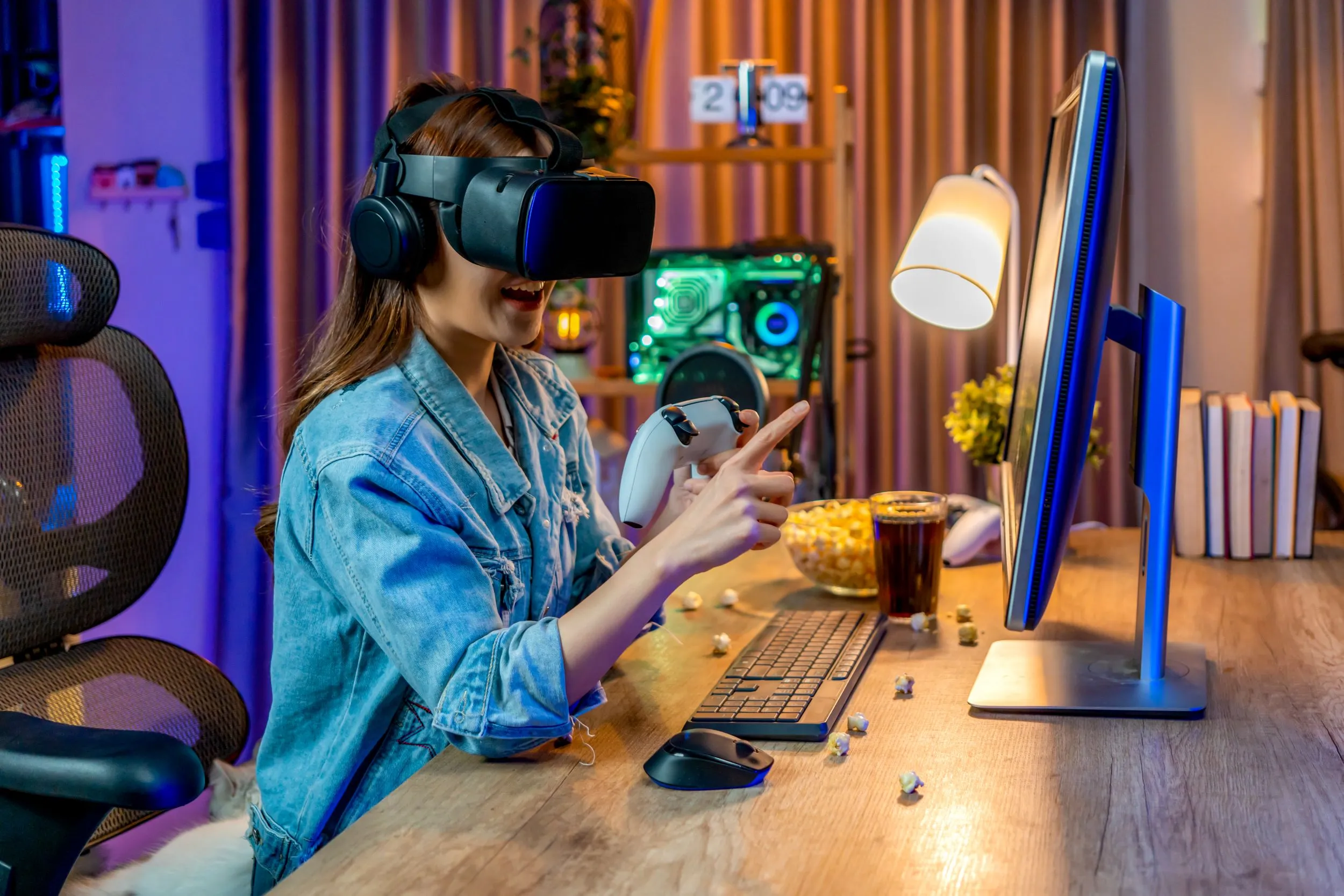
Gaming is going to continue to need more bandwidth as technologies evolve. As more people dive into VR worlds that become increasingly lush and realistic, your internet connection is going to matter even more in the not-so-distant future. And what about when AI starts contributing and creating in real time? That day’s not so far off. You’re going to need a fast internet if you want to experience those things as they’re happening.
Plus, there’s an ROI to consider. Less waiting means more time playing. But gaming isn’t likely the only variable for you. You probably have several smart devices throughout your home, such as streaming devices, AI assistants, and a security system connected to your network. If that’s the case, the more internet you have, the more capable your household becomes.
Don't let your internet be your weakest link
You deserve a network that can keep up, so here’s what Quantum Fiber can do: We’ll give you symmetrical, low latency internet on most plans, without an annual contract.
It’s time to elevate your game. Check your address to see if Quantum Fiber multi-gig speeds are available, and leave lag in the past.
Content Disclaimer - All content is for informational purposes only, may require user’s additional research, and is provided “as is” without any warranty, condition of any kind (express or implied), or guarantee of outcome or results. Use of this content is at user’s own risk. All third-party company and product or service names referenced in this article are for identification purposes only and do not imply endorsement or affiliation with Quantum Fiber. If Quantum Fiber products and offerings are referenced in the content, they are accurate as of the date of issue. Quantum Fiber services are not available everywhere. © 2026 AT&T Intellectual Property. AT&T and the Globe logo are registered trademarks of AT&T Intellectual Property. All other marks are the property of their respective owners.
Content Disclaimer - All content is for informational purposes only, may require user’s additional research, and is provided “as is” without any warranty, condition of any kind (express or implied), or guarantee of outcome or results. Use of this content is at user’s own risk. All third-party company and product or service names referenced in this article are for identification purposes only and do not imply endorsement or affiliation with Quantum Fiber. If Quantum Fiber products and offerings are referenced in the content, they are accurate as of the date of issue. Quantum Fiber services are not available everywhere. © 2026 AT&T Intellectual Property. AT&T and the Globe logo are registered trademarks of AT&T Intellectual Property. All other marks are the property of their respective owners.