

Your 12th player advantage starts here. Fast gaming isn't just about reflexes and skill—it's about having the right internet speed for gaming that keeps you in the action with minimal lag, buffering, or annoying slowdowns. When you jump into a new game with a reliable, high-speed connection, it's like having home-field advantage. Good internet for gaming gives you the performance edge you need to dominate.
This ultimate guide breaks down everything you need to know about gaming internet speeds—from minimum requirements to optimal setups for competitive play. Whether you're building your first gaming station or upgrading to better handle today's bandwidth-hungry titles, understanding what a good internet speed for gaming is can transform your entire experience.
What is a good internet speed for gaming?
You need a minimum of three to six megabits per second (Mbps) to play most multiplayer online games. However, that's just the bare minimum to get you in the game—think of it as the entry-level ticket to the esports arena. For a truly great gaming experience, you'll want significantly higher speeds. Here's what industry experts and testing say about internet speed for gaming:
- Casual gaming: 25-50 Mbps download speed is good for most single-player and casual multiplayer games
- Competitive gaming: 50-100 Mbps download speed ensures minimal lag during fast-paced, competitive matches
- Streaming while gaming: 100 Mbps or higher allows you to game and stream simultaneously
- Multiple gamers or devices: 300 Mbps to 1 Gbps (gigabit per second) is great for a household with multiple players and devices
With fiber internet delivering speeds up to 2 Gig where available, you'll have more than enough bandwidth to dominate while other household members stream, browse, and work online.
What is a good internet speed for gaming?
You need a minimum of three to six megabits per second (Mbps) to play most multiplayer online games. However, that's just the bare minimum to get you in the game—think of it as the entry-level ticket to the esports arena.
For a truly great gaming experience, you'll want significantly higher speeds. Here's what industry experts and testing say about internet speed for gaming:
- Casual gaming: 25-50 Mbps download speed is good for most single-player and casual multiplayer games
- Competitive gaming: 50-100 Mbps download speed ensures minimal lag during fast-paced, competitive matches
- Streaming while gaming: 100 Mbps or higher allows you to game and stream simultaneously
- Multiple gamers or devices: 300 Mbps to 1 Gbps (gigabit per second) is great for a household with multiple players and devices
With fiber internet delivering speeds up to 2 Gig where available, you'll have more than enough bandwidth to dominate while other household members stream, browse, and work online.
How many Mbps do I need for gaming?
A good download speed for gaming depends on how you game. Here's what you can expect at different speeds:
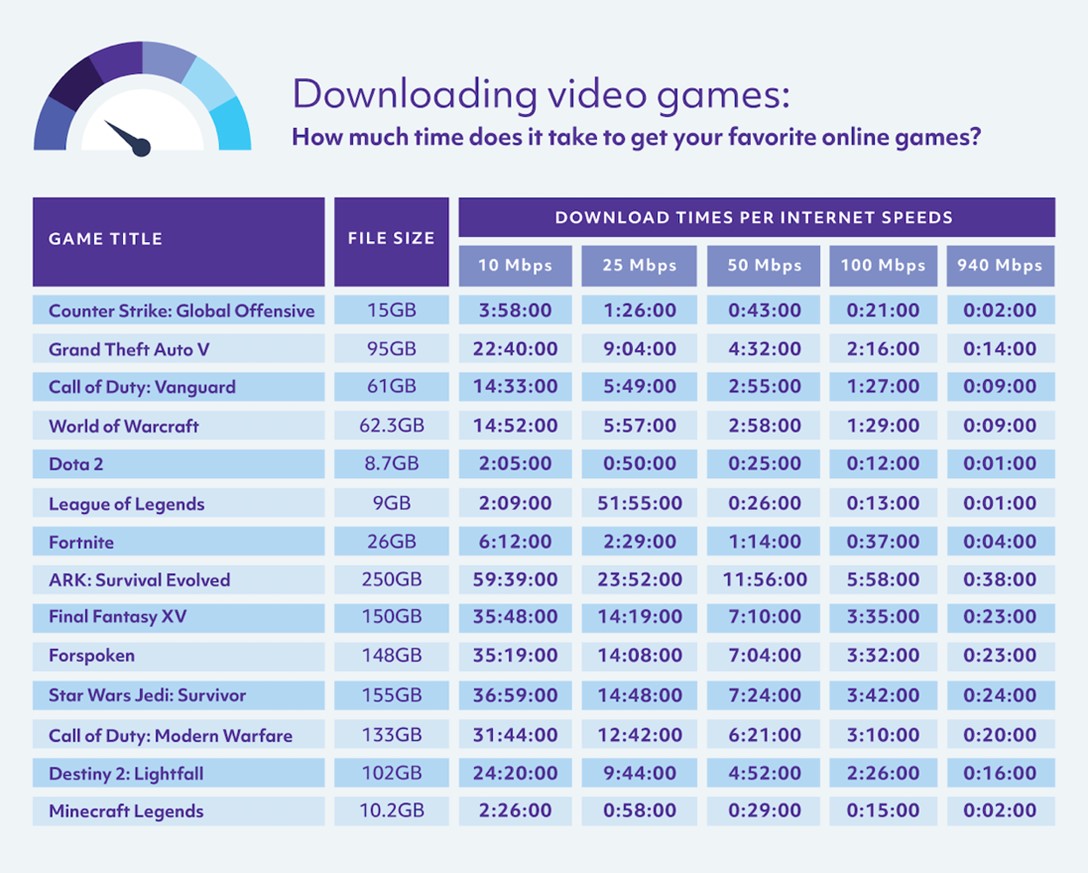
- Under 25 Mbps: You'll likely experience longer download times and some lag during gameplay. A big game like GTA 5 could take 45 hours or more to download with a traditional 5 Mbps connection.
- 25-50 Mbps: Good for standard gaming and HD streaming, though you may experience slowdowns if you have multiple devices online at the same time.
- 50-100 Mbps: Great for competitive gaming because it can support several devices online without noticeable slowdowns.
- 100-500 Mbps: Excellent speed for multiple gamers, streamers, and connected devices.
- 500-940 Mbps: Premium speeds that handle anything you throw at them. With 940 Mbps fiber internet, you'll download GTA 5 in less than 15 minutes. .
- 1 Gbps and multi-gig: This is the ultimate gaming setup. It can handle ultra-fast downloads, 4K streaming, serious gaming, and more.
What about upload speed?
Download speeds are important, but upload speeds are perhaps even more critical for gaming, especially if you're:
- Broadcasting on Twitch, Discord, or YouTube
- Voice chatting when playing
- Sharing game clips and screenshots
- Hosting game sessions for friends
Look for upload speeds of at least 10 Mbps. Fiber internet offers symmetrical speeds on most plans, meaning upload and download speeds are the same.
Understanding bandwidth vs. speed for gaming
Here's something that trips up a lot of gamers: knowing the difference between bandwidth and how much data games actually use.
Bandwidth is the size of your internet pipeline. It's measured in megabits per second (Mbps) and tells you how much data can flow through at once. Data usage is how much data you actually use while gaming. It's measured in Megabytes per hour (MB/hr) or Gigabytes per day (GB/day).
How much bandwidth does gaming actually use?
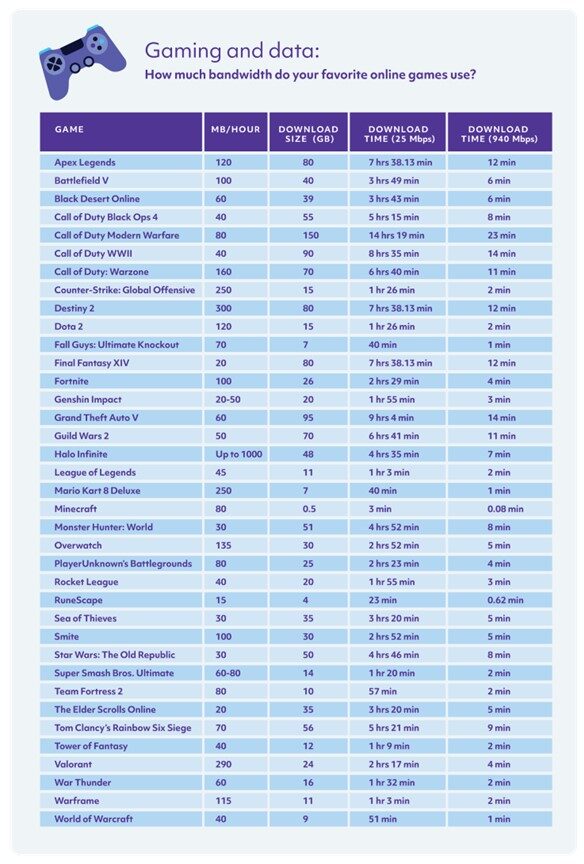
Online gaming uses less data than you'd think. Most games use relatively little bandwidth compared to streaming a movie. Check out what popular games actually consume:
- Low-bandwidth games: RuneScape and Final Fantasy XIV sip data at under 50 MB/hr
- Moderate-bandwidth games: Fortnite, League of Legends, Mario Kart World, and Minecraft hover around 50-100 MB/hr
- Higher-bandwidth games: Call of Duty: Warzone, Destiny 2, and Counter-Strike: Global Offensive use 100-300 MB/hr
- Bandwidth-intensive games: Halo Infinite is the data hog at roughly 1,000 MB/hr (1 GB/hr)
Even Halo Infinite only consumes about 0.2 percent of an up to 940 Mbps fiber connection. The real bandwidth eaters? They're not your games—they're things like 4K streaming, massive file downloads, and video calls happening at the same time.
Best internet speed for gaming and streaming
Streaming to Twitch, Discord, or YouTube demands solid upload bandwidth on top of what your game needs. Here's what to consider:
- 720p streaming at 30 frames per second (fps): 3-5 Mbps upload
- 720p streaming at 60 fps: 4.5-6 Mbps upload
- 1080p streaming at 30 fps: 4.5-6 Mbps upload
- 1080p streaming at 60 fps: 6-9 Mbps upload
Now add in the gameplay itself and voice chat, and you need at least 100 Mbps download and 10 Mbps upload for smooth simultaneous gaming and streaming. Fortunately, fiber internet can deliver nearly symmetrical speeds for both without causing slowdowns for either.
Sharing bandwidth with your household
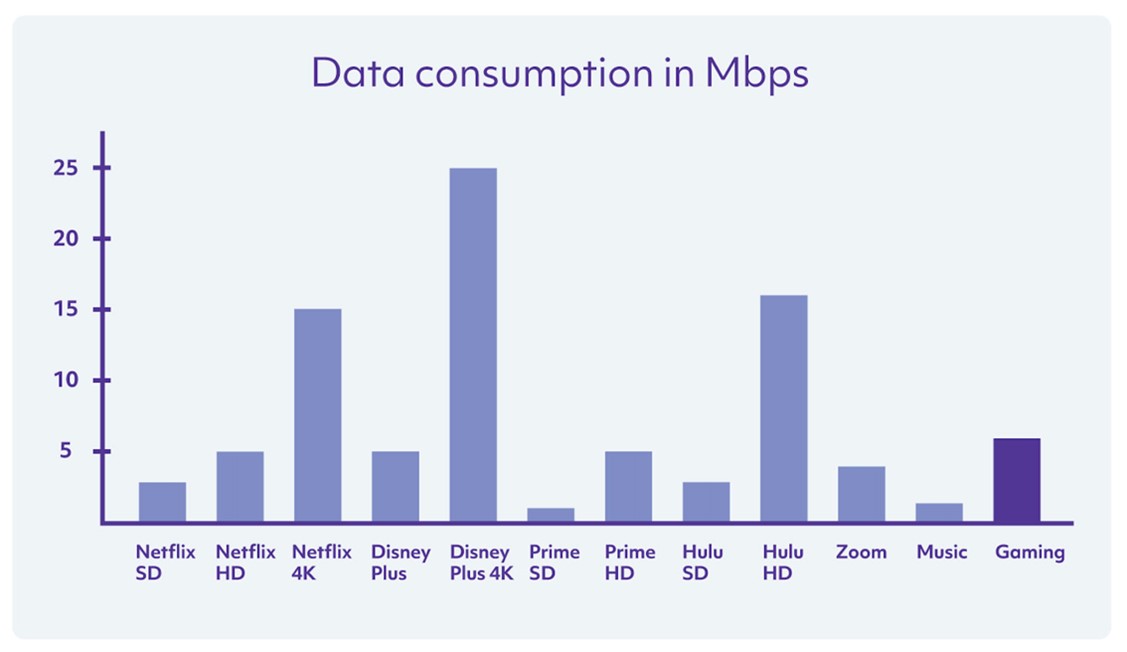
Your connection isn't just about gaming. It's also handling whatever else is going on in your house. Let's look at a real-world scenario:
- Your gaming: 6 Mbps
- Four people streaming 4K video: 80 Mbps
- Two YouTube streams in other rooms: 5 Mbps
- Couple of music streams: 3 Mbps
- Someone on a Zoom call: 4 Mbps
- All your smart home stuff: 2 Mbps
That's 100 Mbps right there. But with an up to 940 Mbps fiber connection, or even better, one that goes up to 2 or up to 8 Gig? You've got room for everyone to do their thing—no more family arguments about who's taking all the Wi-Fi.
What's a good ping for gaming?
Speed tells part of the story, but ping (or latency) is where competitive gaming gets won or lost. Ping measures in milliseconds (ms) how long it takes for your signal to reach the game server and come back. Think of it as reaction time—the lower your ping, the faster your actions show up on screen.
Here's what different ping levels feel like in-game:
- 1-20 ms: This is esports territory—what the pros play on
- 20-40 ms: Excellent for competitive play, everything feels crisp
- 40-60 ms: Still good, totally playable for most competitive games
- 60-100 ms: You'll start noticing lag in fast-paced matches
- Over 100 ms: Frustrating delays that put you at a serious disadvantage
While 1 ms is the fastest ping speed, anything under 60 ms works great for competitive play. When latency is this low, your actions feel instant—you fire, your characters fire. No delay.
How to optimize your home network for gaming
Getting the right internet speed for gaming and streaming isn't just about a fast connection speed. It also requires that your whole network functions better. Let's talk optimization and how to fix internet issues for better gaming.
- Wi-Fi vs. wired connections: If you can, physically run an Ethernet cable from your router to your PC or console. Wired connections crush wireless for stability and latency.
- Reduce network congestion: All your devices share your bandwidth. If your router has Quality of Service (QoS) settings, use them to set your gaming device as the priority over everything else.
- Place your router strategically: Put it in a central location, up high, and away from walls and metal objects.
- Update your equipment: Old routers, modems, and even Ethernet cables can choke your connection, so be sure to have the latest technology. Learn how Wi-Fi 7 makes a difference for gamers.
Speed up your gameplay with fast, reliable fiber internet from Quantum Fiber. With lightning-fast speeds and 99.9 percent reliability based on network uptime or availability, you'll be ready to dominate any game, stream with virtually no buffering, and support your whole connected life.
Frequently asked questions about internet speed for gaming
Is 100 Mbps good for gaming?
Yes, 100 Mbps can be a good speed for gaming, but it depends on what else is happening on your network. You'll want faster speeds if you have multiple devices in your house, stream in 4K, or broadcast your gameplay.
How much data does gaming use?
Gaming uses way less data than you'd expect. Most games use 50-100 MB per hour. Even Halo Infinite consumes about 1 GB per hour. Compare that to 4K streaming at 7-12 GB per hour. More important than data usage is how much bandwidth gaming and other activities use.
Can I game over Wi-Fi, or do I need Ethernet?
You can game over Wi-Fi, but a wired Ethernet connection gives you better latency and stability. When milliseconds matter, wired is the way to go.
Does fiber internet improve gaming performance?
Fiber gives you ultra-fast speeds, low latency, and symmetrical upload and download speeds on most plans, which make gaming fast and your connection reliable.
Content Disclaimer - All content is for informational purposes only, may require user’s additional research, and is provided “as is” without any warranty, condition of any kind (express or implied), or guarantee of outcome or results. Use of this content is at user’s own risk. All third-party company and product or service names referenced in this article are for identification purposes only and do not imply endorsement or affiliation with Quantum Fiber. If Quantum Fiber products and offerings are referenced in the content, they are accurate as of the date of issue. Quantum Fiber services are not available everywhere. © 2026 AT&T Intellectual Property. AT&T and the Globe logo are registered trademarks of AT&T Intellectual Property. All other marks are the property of their respective owners.